Sep 5, 2026Buying Guides
All-in-One Stationery Case or Separate Kit? A Buyer’s Guide
Compare an all-in-one stationery case with a separate school kit, including components, replacement planning, sample checks and retail positioning.
A compact stationery set can look like an easy buying decision. The case is neat, the contents are visible, and the buyer can imagine one clear SKU on a retail shelf or inside a promotional campaign. Then the operational questions arrive: What if one component changes? Can users replace a pen locally? Will the inspector check every item inside every case? And should the next order repeat the whole set or only the consumable pieces?
Those questions do not mean an integrated set is a poor choice. They mean the format should match the channel. The real decision is not “more functions or fewer.” It is whether the bundle itself creates value, or whether long-term component flexibility matters more.
Start with the job the kit must do
An all-in-one stationery case is strongest when the buyer wants one coordinated product: a compact school starter set, a retail gift, or a promotional item that is ready to present. A separately assembled kit is often stronger when each component follows its own specification, replenishment cycle or tender requirement.
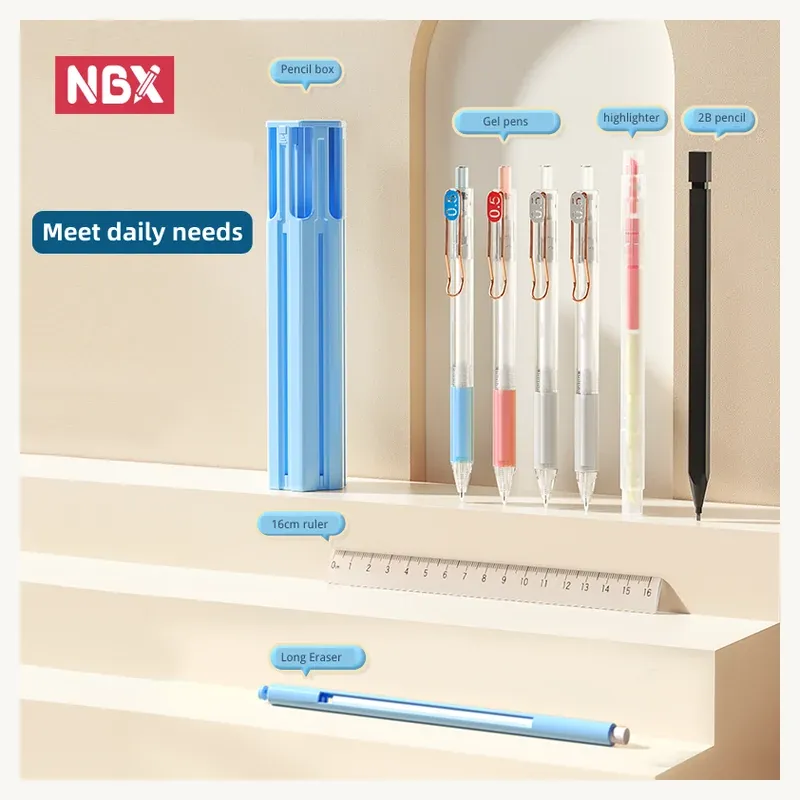
The NBX 2026 catalogue provides a useful real example. Its Portable Pencil Case Plus is described as a compact five-in-one format containing a gel pen, a 2B mechanical pencil, a two-color highlighter, a ruler and an eraser. Each item has an independent position inside the case. The catalogue also lists 88 pieces per carton and describes the case as easy to carry.
These are product-specific facts, not universal rules for every stationery set. They show why the sourcing unit matters: the buyer is not approving only a pencil case. The buyer is approving a case, five stationery functions, the way those parts fit together, and the finished presentation.
Choose an integrated case when the bundle is the product
For a gift company or retailer, the integrated format can create a stronger story than a loose assortment. The customer opens one object and finds the everyday essentials arranged in fixed positions. The case itself becomes part of the experience instead of being disposable outer packaging.
This route is especially useful when:
- the set will be sold or distributed as one SKU;
- a compact, organized presentation is central to the offer;
- the same component list can remain stable across the order;
- the buyer is prepared to approve every item, not only the outer case.
The trade-off is coordination. If the pen color, pencil grade, ruler markings, highlighter colors or eraser format changes after approval, the completed set changes too. A visually similar substitute may still alter how the kit works or how it is described on the package.
Freeze a bill of contents before quotation
A photograph is not a bill of contents. Before asking for a final quotation, write one line for every component. Record the product name, required function, visible color, artwork location, quantity per set and any detail that cannot be substituted without approval.
For the Portable Pencil Case Plus, that record should at least identify the gel pen, 2B mechanical pencil, two-color highlighter, ruler and eraser, plus the case color and packaging. Do not convert an image into assumptions about ink color, tip size, material or refill compatibility. If a detail matters in your market, ask for it explicitly.
This one-page record reduces a common repeat-order problem: both sides remember “the same set,” but they are remembering different details.
Approve the kit as a system
Component samples can pass individually and still feel awkward in the finished case. During sample review, use the same representative load every time and check the complete routine:
- Count every component against the approved bill of contents.
- Remove and return each item without forcing it into the assigned space.
- Close the case with the complete load in place.
- Confirm that ruler markings, pencil grade, highlighter colors and other agreed details match the approval record.
- Review the retail or promotional package against the final contents statement.
These are general buyer checks, not a claimed factory testing standard. Add market-specific safety, labelling and compliance requirements to your own quality plan. For a broader framework, use our custom stationery quality-control checklist.
Choose separate items when replenishment matters more
Separate sourcing may be the safer route when a school program expects frequent replacements, when a tender specifies each item independently, or when the buyer wants to change one component without reopening the whole kit.
It gives the buyer more freedom to compare pens, pencils, rulers and erasers as separate purchasing decisions. It can also make local replenishment easier if the required replacements are already available in the destination market. The trade-off is that the buyer must manage more SKUs, more packaging decisions and possibly more assembly work.
Ask one practical question: what happens after the first pen is used up or one component is lost? The NBX catalogue says the Portable Pencil Case Plus can store most gel pens on the market. That is useful context, but it is not a promise that every locally sourced replacement will fit or match the original presentation. Bring the intended replacement to sample review, or provide its dimensions and confirm fit before ordering.
Match the route to the sales channel
Use the following decision guide before requesting a sample:
- Promotional gift: Prefer an integrated case when the coordinated experience and branding matter more than long-term replenishment. Freeze exactly which items carry artwork.
- Retail stationery SKU: Prefer an integrated case when the package can state the exact contents and the range can keep that configuration stable.
- School program or tender: Consider separate items when each component has its own mandatory specification or replacement schedule. Use an integrated case only when compact organization is part of the requirement.
- Test launch: Keep the first customization scope controlled. Validate the product and channel before adding deeper color, pattern or packaging changes. Our custom stationery MOQ planning guide explains why the configuration must be defined before the minimum quantity is reliable.
Red flags are simple: a quote that says only “stationery set,” a sample with no component record, packaging that does not name the contents, or an unapproved substitution presented as equivalent. Any of these makes repeat orders and inspections harder.
Send a brief that lets us compare both routes
When you contact Aura Craft World, send the target market and channel, intended user, expected quantity, must-have components, logo or artwork scope, packaging idea, replacement expectations and target delivery window. A reference image is helpful, but pair it with the written bill of contents.
NBX and Dongguan Xingbo Stationery Co., Ltd. can then review the current product configuration, sample route and feasible OEM/ODM scope without pretending that an undefined set already has a final price or minimum. Start with the Portable Pencil Case Plus, or request a comparison between an integrated case and a separate kit for your channel.
The best format is not the one with the longest feature list. It is the one your customer understands, your team can inspect, and your next order can repeat without surprises.