Correct-Grip Mechanical Pencils: A Buyer’s Lead, Grip and Packaging Sample Check
Test grip orientation, 1.3 mm lead feed, tip rotation and pack contents before approving correct-grip mechanical pencils for school retail orders.
A sample can look charming: a flower on the top, bright colours and a molded grip that differs from an ordinary mechanical pencil. The difficult moment comes later. A child turns the guide the wrong way, the refill is not a standard thin lead, or the retail pack lacks an accessory shown in the artwork.
Approve an ergonomic school pencil as a system, not only a colourful barrel. The grip, orientation cue, lead, feed action, tip and package must make sense together.
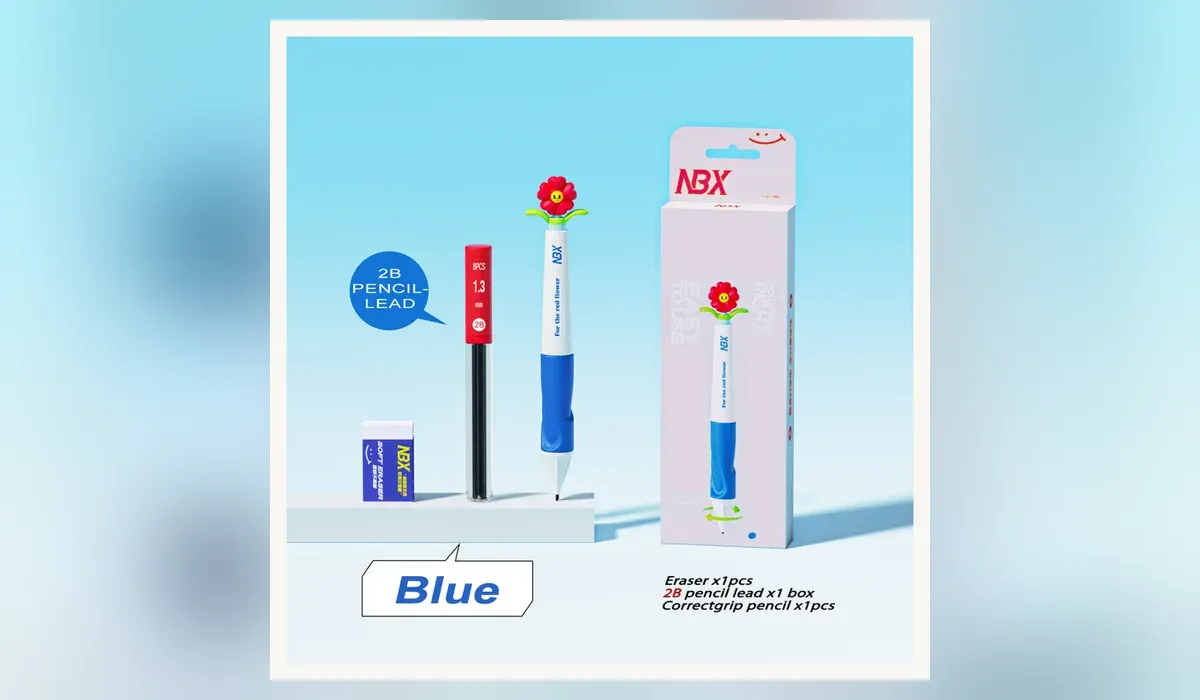
NBX materials show a three-finger position with the smiley face forward, a flower-shaped top used to advance the lead, a tip that rotates when the writing edge becomes blunt, and a retail set with one pencil, one eraser and eight 1.3 mm 2B leads. The current product page also lists OEM/ODM colours, branding and packaging. These are model-specific details; the quotation and sample must define the version ordered.
1. Freeze the exact version before comparing prices
“Correct-grip pencil” is not a complete specification. Two products can use the same description while differing in grip geometry, lead size, hardness, included accessories and retail presentation.
Start with a one-page version sheet recording barrel, grip and flower-top colours, lead specification, refill quantity, eraser and package. NBX assets show blue, orange and multicolour presentations. The pictured set identifies 1.3 mm 2B lead, eight refills, one eraser and one pencil.
Do not assume every colour or quotation includes the same contents. Ask the supplier to mark any optional item and any detail that changes the price. If you compare quotes without freezing the contents, the lowest number may simply describe a thinner pack.
2. Test whether the grip cue is understood without coaching
The NBX usage image tells the writer to keep the small red smiley face facing forward. That visual cue is useful only if the intended user notices it and can repeat the position.
Give the pencil and proposed package to representative users without a spoken demonstration. Observe whether they find the forward cue, place three fingers in the molded areas and begin writing comfortably. Then show the instruction and repeat. Record hesitation instead of asking only whether they “like” it.
Check right- and left-handed use separately. A shaped grip can guide one position well while feeling restrictive at another angle. This is not a medical test, and the product should not carry therapeutic claims without appropriate evidence. The buyer’s practical question is simpler: can the target student understand and use the design as sold?
3. Run one repeatable lead-feed and tip test
The product images show a full-length lead inserted from the top and advanced by pressing the flower. They also show the tip being rotated so a sharper writing edge can be used when one side becomes blunt. Those functions are the reason to test the complete writing routine, not merely make a few marks.
Use the same paper and pressure for every sample. A simple approval sequence is:
- Confirm the lead marking and measure the supplied refill against the agreed specification.
- Load the lead using the instructions supplied with the sample.
- Press the flower repeatedly and check that the feed action is understandable and consistent.
- Write several lines, rotate the tip as shown and confirm that the user can continue without sharpening.
- Remove or replace the lead only by the approved method, then repeat the cycle.
- Inspect the tip, grip and top button after the test for looseness, cracks or parts that no longer align.
The number of cycles and acceptance limit should be written into your own inspection plan. “Mechanism works” is too vague for a pre-shipment check because two inspectors may interpret it differently.
4. Approve lead grade and replacements as buying decisions
NBX SKU materials show both HB and 2B versions, while the pictured retail set uses 1.3 mm 2B leads. Lead grade affects the mark and the user experience, so it should appear in the purchase specification, packaging copy and inspection checklist rather than being treated as a hidden component.
Replacement planning matters too. A school programme may need spare refills with the first order. A retailer may prefer an included tube so the system is immediately clear. A gift project still needs an answer when the original leads are used.
Before approval, ask whether replacement leads will be included, sold separately or sourced locally. If local replacement is part of the plan, test the exact intended refill in the sample. Do not infer compatibility from the words “mechanical pencil.” Lead diameter, length and feeding method must match the approved version.
5. Make the retail pack explain the product honestly
An unfamiliar mechanism needs more than playful packaging. The front should identify the product; the back or insert should show grip orientation, loading and advancement in a few visual steps. The contents statement must match what is inside.
For the pictured NBX set, a buyer should verify the pencil, eraser and eight-piece 1.3 mm 2B lead tube against the final artwork. Also check the SKU or barcode, destination-language copy, importer information, colour indicator and any age or compliance labelling required by the target market.
Approve the loaded package, not separate artwork files. Shake and handle it as a retail carton would be handled. Confirm that the lead tube and eraser stay in position, the flower top is protected and the display face still reads correctly. For a broader artwork and pack workflow, use our custom stationery packaging guide.
6. Use these red flags and RFQ questions
Pause approval if the sample has no lead marking, if the quoted contents differ from the artwork, if the grip orientation cannot be explained simply, or if the replacement route is “standard lead” without a confirmed diameter and loading test. Other red flags include a flower button that sticks, a rotating tip that loosens, colour parts that do not match the approved sample, or packaging that hides which grade is included.
Send these questions with your RFQ:
- Which exact pencil version, colours and pack configuration are quoted?
- Is the lead HB or 2B, what is its diameter, and how many refills are included?
- Is an eraser included, and is it replaceable or a separate accessory?
- What loading, feed and tip-rotation instructions will appear in the pack?
- Which surfaces can carry a logo, and which colour or packaging changes affect MOQ?
- Can the pre-production sample match the intended lead, colours, artwork and final contents?
- What checks will confirm mechanism operation, appearance and pack completeness before shipment?
Use the approved sample and written version sheet together during inspection. Our stationery quality-control checklist provides the wider order framework, while the NBX CorrectGrip Mechanical Pencil page shows the current product presentation.
Aura Craft World works with NBX and Dongguan Xingbo Stationery Co., Ltd. on creative student stationery and model-specific OEM/ODM enquiries. To request this pencil, send your target market, expected quantity, preferred HB or 2B version, colour, logo scope, retail-pack idea and required delivery window through our quotation form. We will confirm the available configuration, sample route and the information needed for an accurate quotation before you commit to bulk production.