Sep 10, 2026Buying Guides
Battery-Free Light-Up Gel Pens: A Buyer’s Sample Check
A writing-first sample check for battery-free light-up gel pens, covering press activation, flash consistency, refill details, packaging and channel fit.
A light-up pen still has to earn its place as a pen
At a buyer meeting, an illuminated pen gets attention quickly. Someone presses the top, the light flashes, and the product passes from hand to hand. The difficult moment comes later: will it write reliably, will the effect repeat, and will a customer understand what is special without a salesperson standing beside it?
That is why a novelty feature should never be approved on surprise alone.
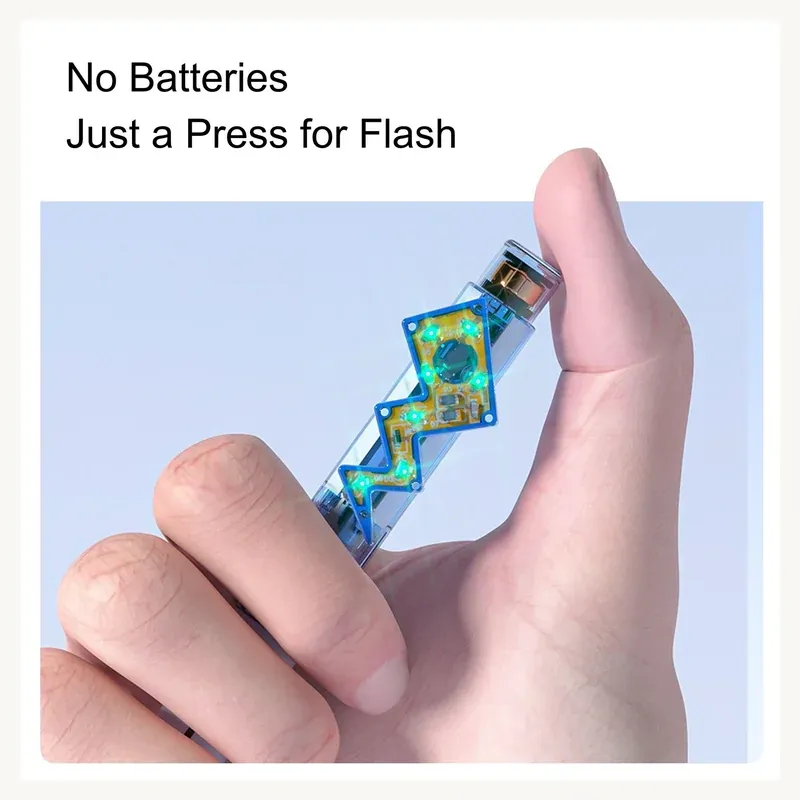
The NBX Flash Gel Pen uses a press-generated light effect. Product material states “No Batteries” and “Just a Press for Flash,” and explains that pressing converts kinetic energy into electricity for the light. The illustrated internal diagram identifies a power-generation unit and lighting components. A separate visible chamber is designed to show the ink level.
The product card lists a 157 mm length and 11 mm diameter, four body-color names—cyan-blue, black, blue and purple—and a single-pack presentation. These are useful facts, but they do not replace physical approval. A buyer still needs to test two products at once: an everyday writing instrument and a small kinetic light mechanism.
Decide whether the effect supports your channel
A flash feature can make sense when the demonstration is part of the value. A gift company may want an item that creates a brief interaction at an event. A creative stationery retailer may use the visible mechanism as a product story. A school-supply buyer may see curiosity value but need especially clear instructions, appropriate user review and target-market documentation.
It may be the wrong choice when the project is driven only by the lowest unit cost, when a conventional pen must be instantly familiar, or when the package cannot explain the interaction. Battery-free operation removes the need to load or replace a battery in the normal use described by the product material. It does not mean that writing quality, mechanical consistency, packaging or market-specific requirements can be skipped.
Before asking for a quotation, write one sentence: “This pen is for [user] in [channel], and the flash should help them [purpose].” If the purpose is vague, the feature may be adding complexity rather than value.
Run two approval tracks on the same samples
The checks below are general buyer guidance, not a claimed NBX factory protocol. Agree the sample quantity and acceptance limits with the supplier for the actual order. Keep each sample identified so a pen with a good light but poor writing cannot disappear inside an average score.
Track 1: approve writing without the light
Start with the least exciting part. Confirm the exact refill, point specification and ink color proposed for your order; those details are not established by the product images used for this article.
On paper representative of your market, check the first stroke, line continuity, ordinary writing pressure and visible smudging. Pause, restart and write at different natural angles. Look through the chamber and confirm that the displayed ink level is actually readable in the body color being considered.
Red flags include skipping at first use, point movement, ink on the grip or a chamber that looks attractive but does not give the user a useful view. A flashing sample should not receive approval if its core writing result would be rejected in an ordinary gel pen.
Track 2: approve press, flash and return
Operate the top as a first-time user would. Observe whether a normal press produces the intended flash, whether the top returns cleanly and whether the pen remains ready for writing. Repeat a documented number of presses chosen for the sample plan; do not rely on an unrecorded showroom demonstration.
Test the effect under the lighting conditions that matter to the program: a bright shop, an office desk and, if relevant, a dimmer event environment. The question is not whether the light looks dramatic in a dark photo studio. It is whether the intended user can see and understand it where the pen will actually be sold or used.
Keep notes for each sample:
- press produces the agreed light effect;
- brightness and color appear consistent across the sample set;
- the top returns without sticking or stopping between positions;
- no new looseness, rubbing or unusual sound appears during ordinary operation;
- writing remains unchanged after repeated activation.
If one action fails, record what happened and at which stage. “Works” and “does not work” are too vague for a pre-production sample or an inspection checklist.
Check the feature after refill handling
Request the exact refill specification and replacement sequence for the proposed order. Remove and reinstall only as instructed, then check the first written line and repeat the press-to-flash action. This confirms that routine refill handling does not disturb the visible chamber, top return or internal alignment.
Do not promise compatibility with another refill because it looks similar. Freeze the approved refill and, if replacement refills will be sold, include the matching information in the retail brief.
Make the package explain and protect the interaction
The listed single-pack dimensions are 58 × 16.8 × 209 mm. Treat them as a starting point and confirm the final pack for the actual order, especially if branding, instructions, a barcode or market-specific information will be added.
The package should explain “press to flash” without implying that the light is a flashlight or that battery-free operation removes every documentation requirement. Ask a qualified compliance partner which tests, labels and records apply to the destination market and intended user group. Freeze the approved wording before production.
Also inspect how the pen is restrained. The pack should not hold the top partly depressed, trigger repeated activation in transit or hide the visible mechanism. Our custom stationery packaging guide explains how to review presentation and protection together, while the quality-control checklist helps convert a signed sample into written inspection points.
Send an RFQ that separates confirmed facts from open choices
For a useful quotation, provide:
- destination country, sales channel and intended user;
- estimated quantity and launch date;
- preferred body colors and branding direction;
- required refill, point and ink specification;
- expected light behavior and the proposed sample check;
- retail or promotional packaging format;
- required artwork, barcode, labels and target-market documents.
Aura Craft World presents creative stationery developed with NBX, supported by Dongguan Xingbo Stationery Co., Ltd. in Dongguan, China. You can review the NBX Flash Gel Pen and the wider stationery collection before choosing a sample route.
When you are ready, send the project brief with the fields above. We can then confirm which product details are fixed, which customization requests need evaluation, what the physical sample should prove and what information is still needed before a bulk-order decision.