Sep 1, 2026Buying Guides
Book Stand Pencil Cases: A Buyer's Fit and Stability Check
Check book fit, page turning and desk stability before ordering book stand pencil cases. A practical sample checklist for stationery importers and buyers.
The sample looks convincing: a pencil case opens into a stand, a book rests on it, and the desk looks tidy. Then someone on your buying team asks a less comfortable question: "Will it work with the books our customers actually use?"
That is the question worth answering before you approve a school-supply range or a branded learning kit. A photograph shows one book in one position. It cannot tell you how a stiff workbook behaves near its first page, whether the clips get in the way, or how much room remains for writing.
You do not need an elaborate demonstration. You need representative books, a sample, and a written record of what worked and what did not.
What the NBX model tells you—and what still needs checking
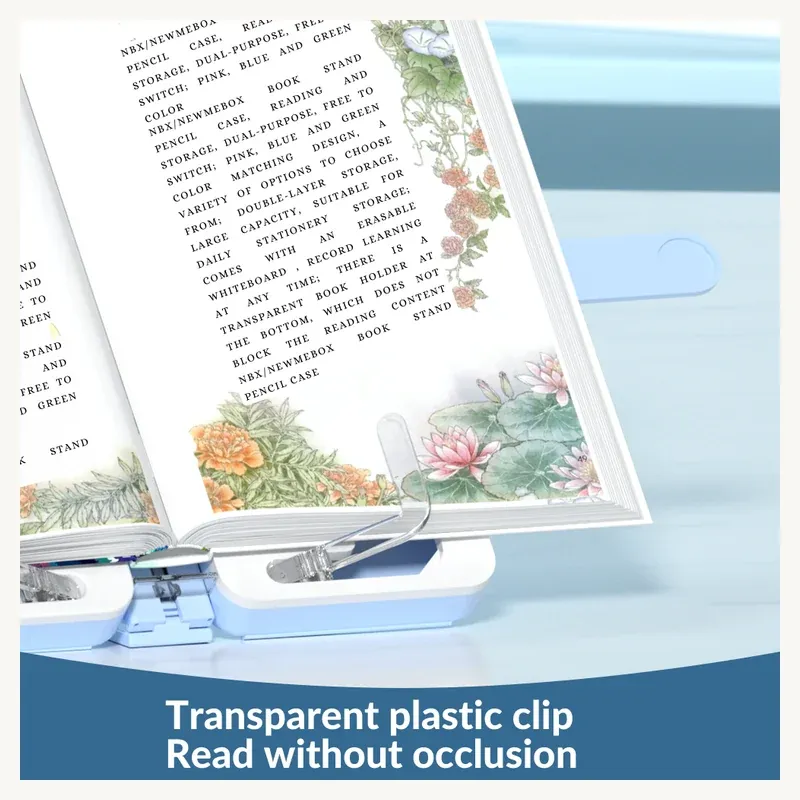
The NBX Book Stand Pencil Case, model NBX-YDJ01 in the NBX catalogue, combines stationery storage with a fold-out reading stand. The catalogue specifies seven adjustment positions, a triangular support structure, a non-slip silicone strip underneath, and transparent book holders. It also lists an erasable whiteboard and a kit containing one product, one sticker, two erasable pens and one cloth.
Those are useful starting points, not a universal book-fit guarantee. The catalogue does not give a maximum supported book weight, thickness or open width. Confirm those limits for your proposed use before committing to a compatibility claim.
For an importer, the distinction matters: a useful combination product can save carrying a separate item, but it should not automatically be treated as a heavy-duty textbook stand. Choose around the reading task, not the number of functions on the box.
Put your books—not just a display book—on the sample
Start with the books your retailer, school distributor or promotion will actually pair with the product. If the range is not fixed, gather representative formats and label them as provisional. Include the thickest planned book, a thin workbook and a book that tends to spring closed.
Record each book's height, open width, closed thickness, weight and binding type. Add its title or reference number so the supplier can reproduce the check. Page count alone is not enough: paper, covers and binding change how a book sits.
The following is a buyer-proposed usability check, not a published NBX laboratory protocol or a substitute for product safety testing.
Check support through a reading session
Ask for the setup instructions first. With an adult reviewer, place the sample on a clean, level desk and confirm the support is properly engaged. Check each of the seven adjustment positions using books within the supplier's confirmed limits; do not force an overloaded setup.
Open each book near the beginning, middle and end. Watch for the base sliding, the support shifting, or one side lifting as the page weight changes. Turn pages normally and repeat on the desk surface intended for the programme, rather than assuming the silicone strip behaves identically on every finish.
A stand that holds a book while nobody touches it has passed only part of the check. Record whether it stays usable while the reader changes pages. Stop if it slips or becomes unstable; a different position may work, but that restriction belongs in the approval record.
Read the page, then turn it
Position the transparent holders over pages with small print, diagrams and text near the lower margin. Transparency does not automatically eliminate reflections or awkward placement. Review the page from the intended seated position under ordinary room lighting.
Release, turn and secure a page as instructed. Check for creasing, catching or the book repeatedly closing. A firm hold is useful only if the reader can still change pages without a struggle. For left- and right-bound books in your range, check both reading directions instead of approving one format for all markets.
Finish the task and pack away
Place a notebook beside the stand and simulate taking notes. Measure the open desk footprint and check access to the pens. A compact closed case can still occupy meaningful space when unfolded.
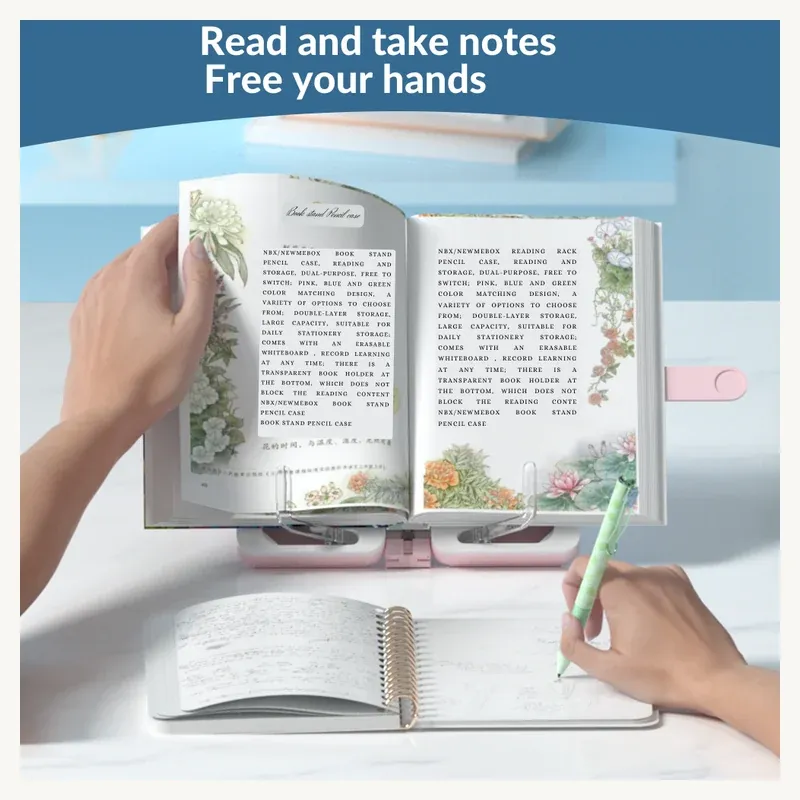
NBX product photo: reading and note-taking share the same desk space. Check this arrangement with the books and notebook used in your own programme.
Then remove the book, return the intended stationery to storage and close the case without forcing it. Check that the holders and support fold away as instructed. If the whiteboard is part of your offer, use the supplied erasable pens and cloth to review writing and wiping; record the elapsed time before wiping so another reviewer can repeat it.
Turn observations into a buying decision
Keep a simple record for each book: book reference, dimensions and weight, stand position, desk surface, page position, observed problem, photo or video reference, and decision. Agree any repeat counts and acceptance thresholds with the supplier rather than presenting your own trial as an industry standard.
Use three outcomes:
- Approve for the defined use: the agreed books work at the agreed positions, page turning is practical, and the complete pencil-case routine works.
- Approve with a narrower scope: some formats work, but others do not. Limit the product description and programme to the supported use; do not hide the exception.
- Pause approval: the support slips, holders mark pages, closure needs force, or nobody can confirm the intended limits. Resolve the issue and review another sample before placing the order.
For a broader order inspection plan, use our stationery quality-control checklist. Keep this book-fit record attached to the approved sample so the practical requirement does not disappear into a general "quality accepted" note.
Send us the books and the brief behind your order
Aura Craft World presents NBX stationery from Dongguan Xingbo Stationery Co., Ltd. If you are considering this model for retail, school distribution or a promotional learning kit, request a book-stand pencil case sample review with:
- The model or product link, plus photos and measurements of the intended books.
- Order quantity, destination market and intended user group.
- Required branding, colours and packaging, with your target delivery date.
- The fit questions or sample concerns you need answered before approval.
Ask us to confirm the current configuration, available sample, applicable use limits and feasible customization before quotation. If retail packaging is included, our packaging planning guide can help you prepare that part of the brief.
You do not need to arrive with every answer. A clear description of the books and the task is a better starting point than a broad promise that a product "works for students."