Aug 26, 2026Buying Guides
How to Source Ergonomic Pencil Grips for School Programs
Evaluate ergonomic pencil grips for school and retail programs, including fit, comfort, usability, packaging, OEM options and pre-shipment checks.
Ergonomic pencil grips occupy a useful space between a basic writing tool and an educational accessory. For stationery importers, school suppliers and retailers, that also makes them easy to misunderstand. A colourful shape may attract attention, but a successful product must fit the intended pencils, feel comfortable in the hand, work simply and remain consistent across a bulk order.
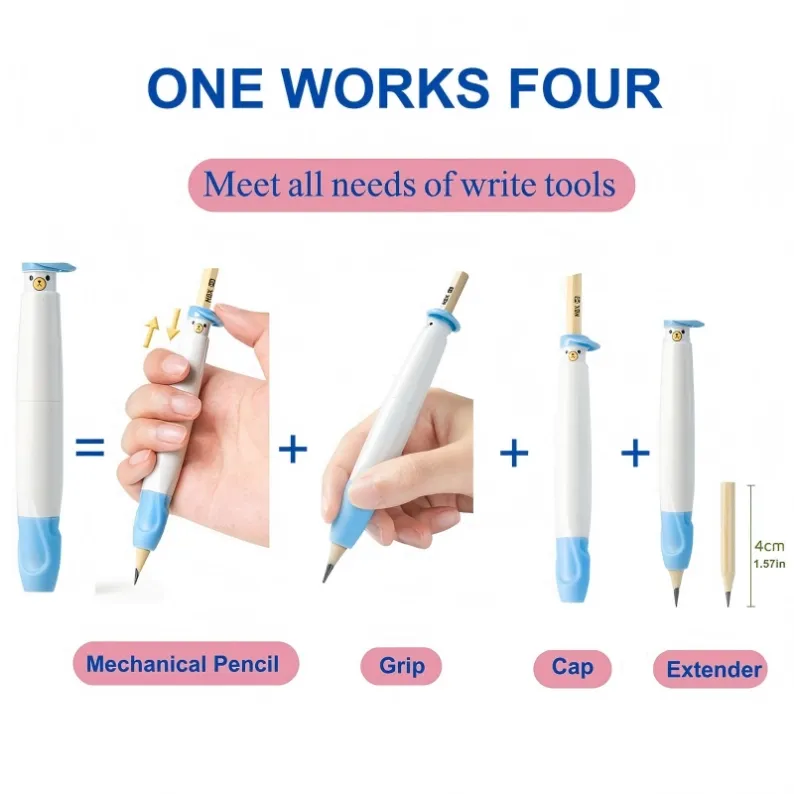
Aura Craft World presents creative stationery from NBX and Dongguan Xingbo Stationery Co., Ltd., an integrated manufacturing and trading company established in Dongguan in 2018. The company focuses on creative and functional student stationery and supports OEM and ODM projects. Its catalogue identifies the NBX-JZ01 Mechanical Pencil Grip as a positioning aid with a grooved grip area, a mechanical lead-out function, compatibility with most ordinary pencils, a pencil-extender function and a silicone grip area.
Those features provide a concrete starting point, but buyers should still evaluate the product against their own market, age group and sales channel. The following framework turns a broad request for an "ergonomic pencil grip" into a clearer purchasing decision.
1. Define the intended user and learning setting
A pencil grip sold through a stationery retailer may need self-explanatory packaging and strong shelf appeal. A school programme may place more weight on simple classroom distribution, repeatable use and clear teacher instructions. A promotional project may require a brandable surface and a colour scheme that matches a campaign.
Begin the request for quotation with the approximate user age, writing environment, product format and destination market. State whether the item will be sold individually, included in a school set or combined with pencils and erasers. This context affects the product configuration, packaging and testing plan.
Avoid making medical or therapeutic claims unless the relevant evidence and market requirements have been independently reviewed. A practical stationery description should focus on finger positioning, holding comfort, ease of use and the intended learning situation.
2. Evaluate the grip geometry
The shape of the contact area is the core of the product. The NBX-JZ01 catalogue describes a positioning-groove design intended to guide finger placement. During sample review, do not look only at the product from the outside. Ask several intended users to hold and write with it for a realistic period.
Observe whether the finger positions are easy to understand without lengthy explanation. Check for sharp transitions, uncomfortable pressure points or areas that become slippery. The product should sit securely on the pencil while allowing normal writing movement.
Different students have different hand sizes and habits, so a buyer should not treat one brief trial as universal proof. Record the age group and trial conditions, then compare several samples using the same checklist.
3. Confirm pencil compatibility with real samples
The NBX-JZ01 is described as compatible with most ordinary pencils, but "most" should still be verified against the pencils used in your programme. Collect representative round, hexagonal or other pencil bodies from the target market and test their fit.
Check whether each pencil can be inserted without excessive force, whether the grip remains stable during writing and whether it can be removed without damage. If the product uses a mechanical function to advance or hold the pencil, operate it repeatedly with the chosen pencil sizes.
For a bundled set, approve the grip and pencil as one complete system. Compatibility problems are much easier to correct before artwork and packaging are finalised.
4. Review materials and touch points
The catalogue identifies a silicone grip area on the NBX-JZ01. For buyers, the relevant questions are not limited to the material name. Review the surface feel, flexibility, colour consistency, odour, finish and the way the soft and rigid components meet.
Ask the supplier to confirm the material specification for the exact quoted version. Destination-market testing or documentation requirements should be stated in the purchase specification and agreed before production. Do not assume that a general material description automatically satisfies a particular market or customer standard.
Samples should represent the requested colour and finish whenever possible. A soft-touch component can look different under production lighting or next to printed packaging, so evaluate the complete presentation together.
5. Test the mechanical and extender functions
One differentiating feature of the NBX mechanical pencil grip is its mechanical lead-out method: the accessory is designed to turn an ordinary pencil into a press-operated format. The catalogue also positions it as a pencil extender, allowing shorter pencils to remain usable.
For a buyer, these are functional claims that need a repeatable test. Operate the mechanism through multiple cycles, check whether the pencil stays secure and confirm that the action remains understandable after repeated use. Test both a full-length and a shorter pencil if the extender function is important to the sales proposition.
Record what counts as acceptable performance. A clear inspection method is more useful than a vague instruction such as "mechanism must work."
6. Plan the retail or school-set packaging
Packaging should explain the product quickly. A simple illustration can show finger placement, pencil insertion and the mechanical action more effectively than a long paragraph. If the grip will be sold with a pencil, list the included components clearly. If the pencil is not included, make that equally clear.
For school distribution, consider compact packs that are easy to count and open. For retail, protect the product while keeping the shape visible. The package may also need a SKU, barcode, colour reference, buyer-supplied language copy and importer information.
Customization is model-specific. Dongguan Xingbo's materials show that packaging, logo and colour changes can involve different minimum quantities depending on the product. Send the model, order quantity and requested changes together so the supplier can confirm the correct MOQ and quotation.
7. Approve the sample against a written checklist
Before mass production, approve a sample that represents the agreed shape, colour, material feel, mechanism, pencil fit, logo placement and package. Keep reference pencils with the approved sample when compatibility is important.
Useful pre-shipment checks include:
- Correct product and colour
- Clean moulding and smooth contact surfaces
- Secure fit with the agreed reference pencils
- Consistent mechanical operation
- Correct components and instructions
- Accurate logo, label and barcode
- Correct quantity per inner and master carton
Sampling and inspection should follow the purchase specification rather than rely on memory. Our custom stationery quality-control checklist provides a wider framework for bulk orders.
8. Send a sourcing brief that can be quoted accurately
Include the following information in the first enquiry:
- Target users and destination market
- Product model or reference image
- Pencil types that must fit
- Required functions and test expectations
- Order quantity and repeat forecast
- Colour, logo and packaging requirements
- Whether pencils or other stationery are included
- Required documentation and inspection plan
- Target delivery schedule
Aura Craft World can help importers, distributors and educational suppliers review the NBX Mechanical Pencil Grip and related writing-support products. To request a model-specific quotation, send your market, quantity, customization and packaging brief. We will confirm suitable options, sampling steps and the applicable MOQ with Dongguan Xingbo Stationery.