Sep 10, 2026Buying Guides
Self-Retracting Gel Pens: A Buyer’s Mechanism Sample Check
A practical sample check for importers evaluating compact self-retracting gel pens: grip action, retraction, refill access, writing and packaging.
The five-second moment that decides whether novelty becomes useful
A buyer can understand a familiar click pen immediately. A compact pen that retracts through a different hand movement has a harder job: it must feel distinctive without making the user stop and wonder what to do.
That tension matters in a showroom, but it matters even more after a shipment reaches a school-supply shop, gift counter or promotional campaign. If the interaction feels natural, the pen becomes something people remember and demonstrate. If the first action is unclear, an attractive product can create avoidable questions, returns or complaints.
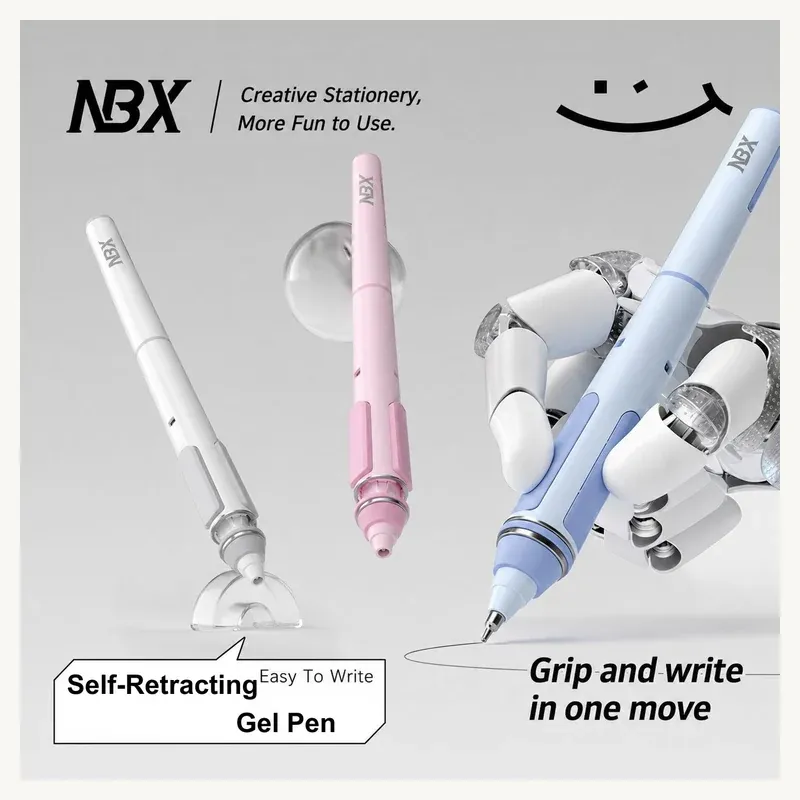
The NBX self-retracting gel pen is designed around three states—writing, retraction and refill replacement. The 2026 catalogue describes an approximately 115 mm format, a TPU grip area and a rotating action: turn left to write, then turn right twice to access refill replacement. The refill-access motion opens like a flower. Those details make the product interesting, but they also tell a buyer exactly what must be approved in a physical sample.
This is not a claim that one mechanism suits every market. It is a practical way to decide whether the format fits your channel before you discuss a bulk order.
First decide what job the pen must do
Do not start by asking whether the pen looks creative. Start by naming the user and the moment of use.
For a gift or promotional program, the compact size and memorable action may help the item feel more considered than an ordinary giveaway pen. For a stationery retailer, the three-state mechanism can create a useful demonstration at the shelf. For a school range, however, the product may need particularly clear instructions and an age-appropriate user trial. A compact body can be convenient to carry, while a buyer planning long writing sessions may want to compare its grip and balance with a full-length pen.
The right question is therefore not “Is this a good pen?” It is: “Is this interaction useful for the people, price position and selling environment in this project?”
Before requesting samples, record:
- the target country and sales channel;
- the intended user group;
- whether the pen will be sold alone, in a set or as a branded gift;
- the expected writing occasion, from short notes to longer classroom use;
- the packaging format and whether printed operating guidance is needed.
That short brief gives the sample test a purpose. Without it, testers tend to approve appearance and overlook the moment when a real customer first picks up the pen.
Run a three-state sample check
The following is general buyer guidance, not a stated NBX factory test standard. Use several samples if possible, keep the test conditions consistent, and record observations rather than relying on “feels fine.”
1. Test first-use understanding
Give the closed pen to a tester without demonstrating it. Ask them to make it ready to write, retract it and prepare it for storage. Observe the first action, where they hesitate and whether they stop between states.
Then show the intended instruction—“turn left to write”—and repeat the task. If the second attempt is clear, the mechanism may need better communication rather than a product change. If confusion remains, discuss the user group and packaging before approval.
Record whether the writing point reaches a consistent, usable position and whether the retracted state protects it for carrying. Do not approve the mechanism only because one experienced salesperson can demonstrate it smoothly.
2. Check writing, grip and recovery together
Write several lines, pause, retract, and start again. Repeat the sequence from different natural hand positions. The catalogue identifies a TPU grip area, but comfort is still a user judgment; ask testers to describe pressure, control and balance instead of promising a universal ergonomic benefit.
Watch for three red flags: the mechanism stopping between positions, the writing point moving under normal pressure, or the user needing a special trick to recover the correct state. Also inspect for visible gaps, rubbing or misalignment after ordinary repeated operation. Agree with the supplier how any issue will be judged during pre-production approval and final inspection.
Ink behavior should be approved separately. Confirm the exact refill and writing specification for your order, then test starting, line continuity and smudging on paper representative of your market. The local catalogue does not establish a point size, ink color or drying-time promise for this article, so those fields belong in the RFQ and approved sample.
3. Verify refill access without assumptions
Follow the documented sequence: after the writing and retraction states, turn right twice to reach refill replacement. Check whether the opening motion is controlled, whether parts remain attached, and whether a user can return the pen to its normal state without forcing it.
Do not assume that a refill which looks similar is compatible. Request the exact approved refill specification and, if replacement refills are part of the offer, test the supplied replacement. Record orientation, insertion, closure and the first line written after reassembly. If your retail promise includes refillability, packaging and after-sales information must match what the approved product actually supports.
Approve the instructions and packaging as part of the product
An unfamiliar mechanism can be easy to use once explained. That makes communication a functional component, not decoration.
Ask whether the pack needs a small three-step diagram for write, retract and replace. Test the wording with someone who has not seen the product. Make sure the pen sits in the package without holding the mechanism in a half-operated position, and confirm that the presentation does not hide the feature a retailer needs to demonstrate.
For private-label projects, freeze the final instruction copy, artwork position, colors, refill specification and packaging together with the physical sample. Our custom stationery packaging guide explains why retail presentation and transit protection should be approved as one system. The broader quality-control checklist can help you turn the approved sample into written inspection points.
Use an approve, revise or redirect decision
Approve the concept when first-time users can reach all three states after concise guidance, the mechanism returns consistently, the writing result matches the agreed specification and the packaging explains the interaction.
Revise when the product is sound but the instruction, pack orientation or user group is wrong. A short demonstration graphic may solve a communication problem; it cannot solve an unstable mechanism.
Redirect to a conventional format when the project needs instant familiarity, extended writing is the main use, or the sales channel cannot explain a new interaction. Choosing a simpler pen is not a failure. It is better than forcing novelty into the wrong program.
Aura Craft World presents creative stationery with NBX while Dongguan Xingbo Stationery Co., Ltd. supports product development and manufacturing coordination in Dongguan, China. You can explore the stationery collection before selecting a sample route.
For a focused evaluation, send a project brief with your target market, sales channel, expected quantity, desired colors or branding, packaging format, intended writing use and launch timing. We can then confirm the relevant product and refill specification, the available customization scope, the sample plan and the next practical step—before you commit to a bulk order.